In their film Beau travail, Claire Denis and her co-writer transpose the story of Herman Melville’s novella Billy Budd, which he worked on until shortly before his death in 1891, to the present day and from seafaring to the French Foreign Legion. Unlike the film, Melville gives his story a precise historical context and makes it clear that the sailor Billy Budd did not volunteer for service on the warship „The Undomidable,“ but was rather forced into it. The merchant ship he previously served on was called „The Right-of-Man,“ where the crew formed „one happy family,“ while on the warship, mistrust and fear reign, and the master-at-arms Claggart weaves a plot that will cost the newcomer Billy his life.
Melville consistently emphasizes Billy’s „perfectly masculine beauty,“ calling him an Apollo, an Adonis, a „radiant star,“ even comparing him to a „village beauty“ who immediately stands out and is recognized among all the others. In the film, the young soldier Sentain is regarded with benevolence and quiet admiration by the commander of the Desert Legion, just as Billy Budd is by the captain. The commander’s adjutant, Galoup, who was never the most handsome but always the most capable, earns the respect of his fatherly commander, but not the affection that comes so easily to Billy and Sentain. He is jealous and orchestrates the downfall of his supposed rival in a salt desert.
The film omits the psychological and social context that Melville provided for his characters to make the individual drama on the ship comprehensible. Beau travail, with its title, refers to the success of a community whose goal is a monolithic masculinity that has nothing to do with Melville, but, even if unintentionally, a great deal to do with Ernst Jünger, who in the 1920s envisioned a war that would give free rein to an „overflowing masculinity“ to find its freedom outside the constraints of civilization, as in the then-emerging French Foreign Legion (The Adventurous Heart, 1929). While for Jünger the rebirth of barbarism from the depths of Eros takes place, as it were, in the bloodstreams of men, albeit in a verbose manner, the film strives, with aesthetic beauty, to show underwater ballets with knives and duels of naked, muscular bodies that transform embraces into acts of violence, as an organic unity, comparable to the neo-heroism that Jünger described and wellcomed in The Fight as an Inner Experience (1922).
In the film, the legionnaires‘ activities in a supposedly „postcolonial“ era are nothing more than meaningless rituals of masculinity. The stylization of the military in behavior and uniform extends to the men’s relationships with one another, so that the depersonalization renders the characters ahistorical and individually indistinguishable.
The nearby village, where advertisements for Coke and Sprite proclaim the presence of colonial power without explaining it, and the secluded and equally impoverished lives of the legionnaires, which the women observe from afar, remain separate worlds. The women see the men cooking, doing laundry, even ironing, and with a birthday cake and candles, as if they were the family they claim to be.
After visiting the Bar des Alpes, where things are quite chaste and the soldiers blow kisses to the women, the men walk through a deserted street at night, carrying one of their own on their shoulders. In the opening pages of Billy Budd, Melville, in a comparable scene, celebrates the „handsome sailor“ whose natural beauty affects both his comrades and passersby. In the film, the group, without witnesses, does not celebrate the miracle of the individual’s selfless beauty, but rather, in a narcissistic yet heroic way, themselves. The brief, incomprehensible scene is reminiscent of the Holy Week procession when the Spanish Legión carries Christo de la Buena Muerte on the cross through Málaga.
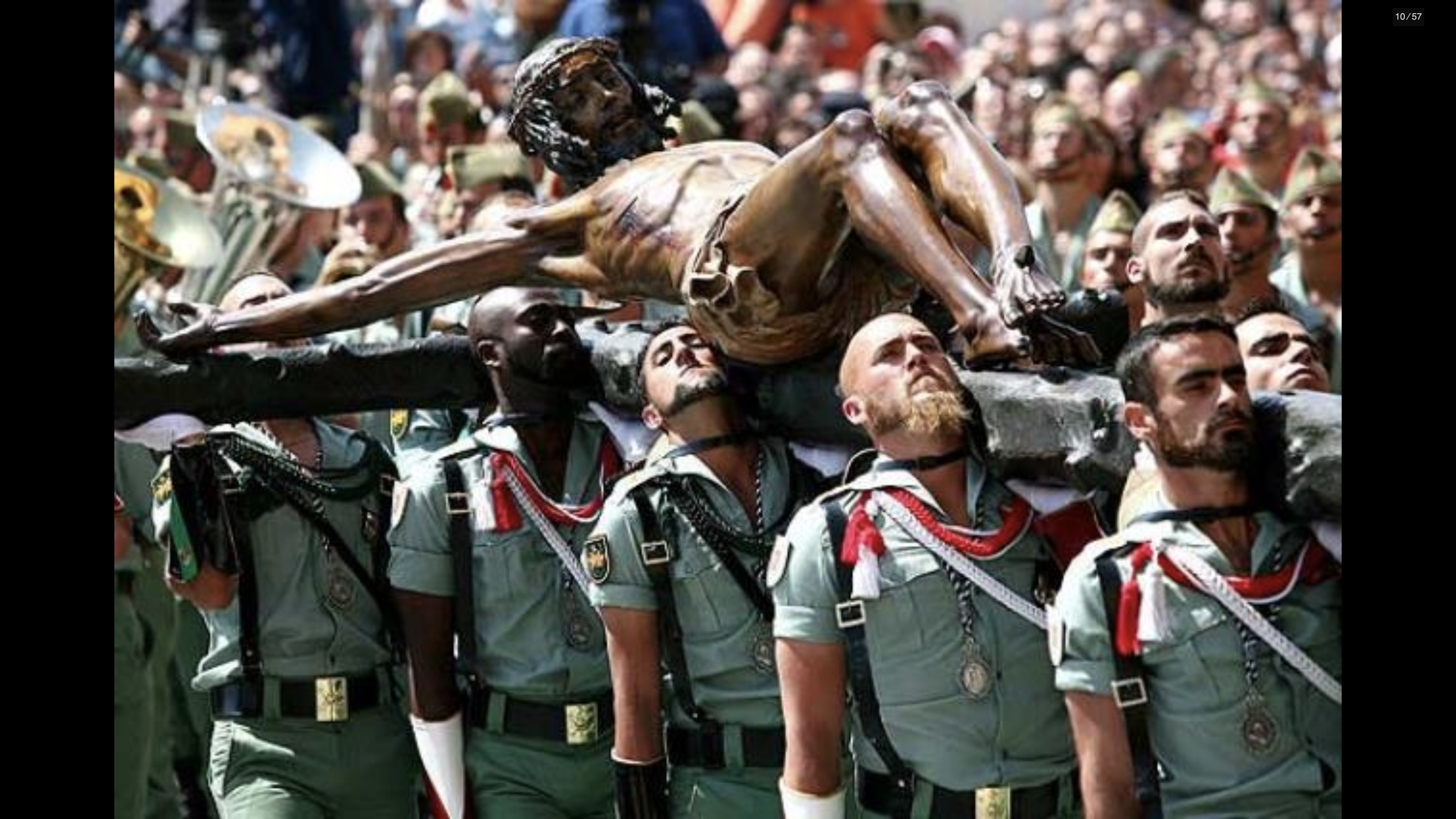
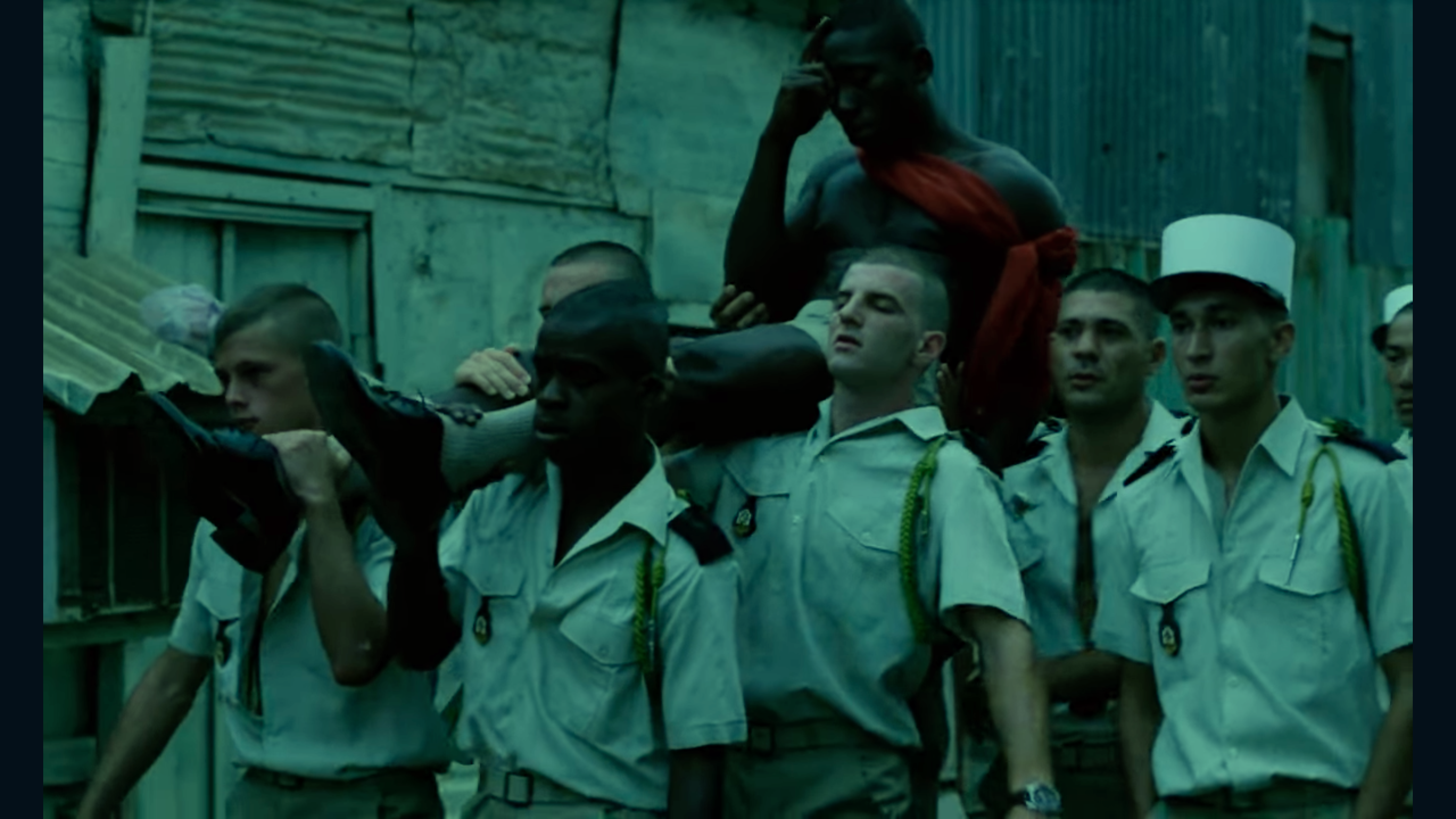
In the film, the sacrificial lamb of the „good death,“ representing all, is a Black man. Eros transforms into the antagonistic Thanatos, to whom the men have pledged themselves because, ready for battle, they cannot make sense of Eros as a symbol of life. What connected Jünger and the Legion at the same time was their admiration for Mussolini and nationalism. This isn’t the film’s central theme, but it explains the unease its overt homoeroticism evokes, because, as in fascism (and quite obviously in the Legion), it presents an Eros it doesn’t intend.
In the film’s final shot, Galoup, dressed in black—he was seen ironing his black shirt—performs a wild dance in an empty bar, which can be interpreted as a breaking down of the military rigidity that also brought with it a rigidity of emotions— an insight on the part of the filmmakers that, unfortunately, comes too late for their wooden character and his victim.
2003 2026

